By Niclas Andersson
Numerous types of roads are in use and each presents unique traffic scenarios. Traffic control applications, including those using automated technologies, such as lidar, must be tailored to the specific conditions of each location. The primary goal of traffic management is to ensure safety for drivers, pedestrians, and cyclists while minimizing disruption to the flow of traffic.
Automated traffic enforcement uses cameras, radar, and/or lasers to capture evidence of drivers committing moving traffic violations, specifically regarding speeding and red-light transgressions.
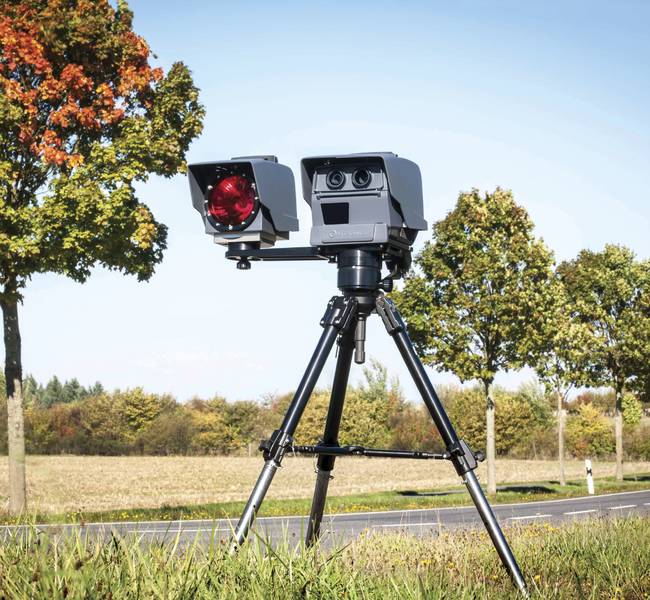
POLISCAN scanning lidar provides short-range and long-range scanning capabilities. Courtesy of VITRONIC Machine Vision.
While traditional high-visibility police enforcement has been an effective countermeasure to reduce traffic violations, automated traffic enforcement programs — when implemented as part of a multidisciplinary approach to traffic safety — are a proven countermeasure for reducing traffic crashes, injuries, and fatalities by promoting safer speeds and optimizing driver behavior.
Traditional patrols
During the past decade, the number of police interventions for traffic violations in the U.S. has significantly decreased. Law enforcement officers in the U.S. are making fewer traffic stops than they did in previous years. For example, traffic stops conducted in Los Angeles in 2023 decreased by >50% compared with traffic stops carried out in 2019. In Pittsburgh, traffic stops decreased by 63% compared with 2017 figures. Traffic stops in Oakland, Calif., have decreased by 71% since 2016, and Seattle traffic stops dropped by 83% between 2019 and 2023.
According to a December 2023 Governors Highway Safety Association report, “Roadway fatalities have increased significantly in recent years, a fact that every safety and law enforcement professional knows all too well. In 2022, 42,795 people died in traffic crashes in the United States. That’s an average of 117 people dying on our roads every single day. Traffic deaths surged 30% over the past decade, with nearly 10,000 more fatalities annually when compared to 32,893 in 2013.”
According to the National Association of City Transportation Officials, “Studies show that automated speed enforcement reduces the percentage of speeding vehicles by up to 65% and can cut the number of serious injuries and fatal crashes by up to 44%.”
Radar versus lidar
The key technologies used in automated traffic enforcement — radar (radio detection and ranging) and lidar (light detection and ranging) — have distinct differences that influence their effectiveness, accuracy, and practicality.
Radar has been used for speed and red-light enforcement for several decades. It operates by emitting radio waves in the form of microwave signals and measuring the time that it takes for these signals to bounce off a moving vehicle and return to the radar device.
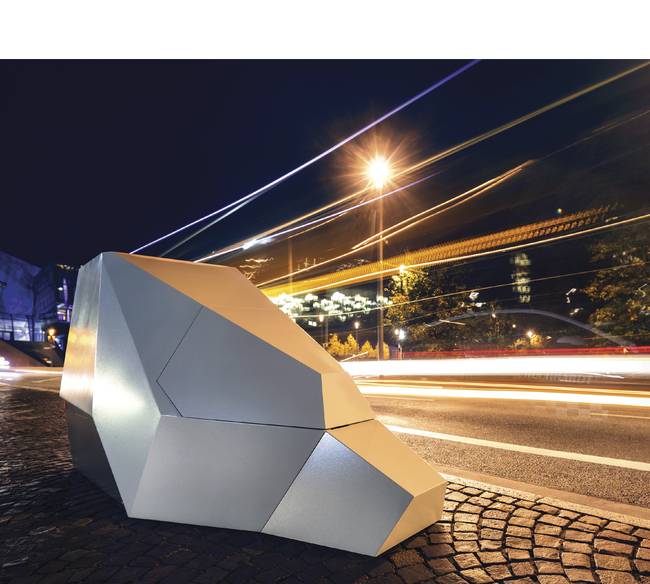
A mobile traffic enforcement trailer uses scanning lidar to detect violations among multiple vehicles, even under conditions of poor visibility. Courtesy of VITRONIC Machine Vision.
Radar can track multiple vehicles simultaneously and assess their speeds. However, it struggles to distinguish between vehicles that are in congested traffic versus those that are closely spaced. Additionally, its ability to measure speed accurately over short distances is limited. These challenges can lead to less reliable speed readings and an increased likelihood of false readings.
Lidar is a method used to determine ranges by targeting vehicles with a laser and measuring the time that it takes for the reflected light to return to the receiver. A lidar device, such as the laser guns the police are using, emits a single laser beam to capture and pinpoint the speed of one vehicle. As a result, evidence gathered through lidar offers a stronger basis for legal cases related to traffic infractions compared with the evidence that can be obtained with radar.
Lidar may operate in a fixed direction, or it may scan in multiple directions, which is known as scanning lidar. Scanning lidar provides a more effective range and a larger field of view compared with fixed-direction lidar. Compared with radar, scanning lidar delivers a major advantage because it provides a broader field of view.
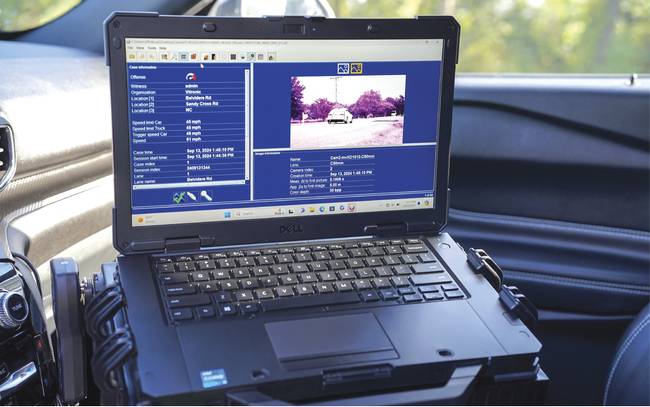
A patrol car enforcement bar display screen. Courtesy of VITRONIC Machine Vision.
The latest generation of precision technology in automated traffic enforcement is POLISCAN, a scanning lidar technology from VITRONIC Machine Vision, which develops specialized products and software for image-based quality inspection, identification, and process optimization.
The key advantage of POLISCAN systems compared with radar and other lidar technologies in traffic enforcement is its ability to accurately measure, track, and record the movement of each individual vehicle within
its field of view, even in complex and congested traffic scenarios with up to six lanes of vehicles moving in both directions. POLISCAN provides an unparalleled level of accuracy and reliability for documenting traffic offenses.
With its laser-based technology, POLISCAN offers short-range and long-range capabilities, making it adaptable to various speed enforcement scenarios, such as inside tunnels, around curves, and on hills. The system’s technology emits 158 separate laser beams across the roadway that pulsate 15,000 times/s while calculating the time it takes for the reflected light to return. These laser beams create a 3D map of the surrounding environment, allowing for highly accurate vehicle speed measurements.
The scanning lidar measurement technology accurately detects the speed of the vehicle as well as the license plate and vehicle class. The vehicle’s direction of travel and lane are also recorded. Thus, the system can be used for speed and red-light enforcement, as well as for automatic license plate recognition.
POLISCAN precisely aligns the dual cameras and the scanning lidar simultaneously. This allows for a clear attribution of the speed to each violating vehicle in every image, without needing complex site calibration or a system setup of radar, which can be prone to failure. The measurement system can be used in stationary, semi-stationary, and mobile applications. It detects traffic offenses without the need for manual operation during ongoing measurement.
Municipal acceptance
Although automated traffic enforcement is sometimes discussed as if it were a new countermeasure, it has been used in the U.S. for decades. Speed safety cameras were first deployed in the U.S. in 1987, while red-light safety cameras were first put into use in 1992.
As of November 2023, 24 states and the District of Columbia permit red-light automated safety enforcement by state law, city ordinance, or both. Twenty-five states permit automated speed-safety enforcement. These state laws generally establish guidelines for municipal governments, but certain laws limit the use of automated enforcement to specific cities or streets, such as school or work zones. Whereas other states do not have laws addressing the use of automated enforcement, deferring decisions to municipalities.
Scanning lidar provides a more effective range and a larger field of view compared with fixed-direction lidar. Compared with radar, scanning lidar delivers a major advantage because it provides a broader field of view.
Critics of automated speed and red-light enforcement argue that these systems primarily serve to generate revenue for law enforcement agencies and technology providers. However, the true objective is to deter violations rather than simply catch offenders. Signs and publicity campaigns often inform drivers that photo enforcement is in place. Though a common aspect of all traffic enforcement programs is that fines from violators generate revenue, the ultimate goal is to enhance compliance with safety laws by changing driver behavior. Ideally, as drivers stop running red lights or speeding, revenue from automated enforcement will decrease.
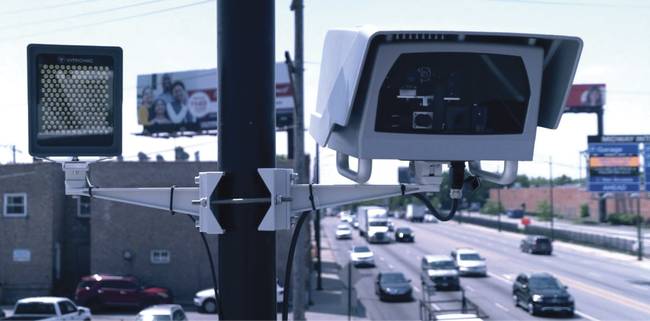
Red-light traffic enforcement. Courtesy of VITRONIC Machine Vision.
A critical aspect supporting the community’s acceptance of automated enforcement is the quality of the technology. If the technology selected for implementation is of poor quality, the public may question its credibility. Municipalities should consider factors such as the accuracy and image quality of photographs, and the reliability, accuracy, and thresholds set for enforcement, such as speed and signal timing, which should be reasonable and publicly justifiable.
Any automated traffic enforcement program that is perceived to be revenue-focused, inaccurate, or implemented in a section of a community without justification will ultimately prove to be unsuccessful. Therefore, it is up to elected officials, law enforcement professionals, transportation engineers, community leaders, and service providers to help guide the automated enforcement implementation process, and secure resources such as funding, data, and technical expertise for communities seeking to implement a program. ?
Meet the author
Niclas Andersson is vice president of business unit traffic for VITRONIC Machine Vision North America. He held executive positions at Sierra Wireless, Arrow Electronics, T-Systems North America, Deutsche Telekom, and Telenor. Andersson has a bachelor’s degree in business economics from Kungsgard College in Sweden; email: niclas.andersson@vitronic.com.