Full company details
Thorlabs Inc.
 43 Sparta Ave.
Newton, NJ 07860
United States
Phone: +1 973-300-3000
Fax: +1 973-300-3600
Photonics in Transition: Strategic Insights from the Global Photonics Economic Forum
Photonics.com
Oct 2025BY ANDREAS THOSS, CONTRIBUTING EDITOR
MALAGA, Spain — With most of northern Europe already gray and wet, early October still felt like summer on Spain’s Costa del Sol. That warmth seemed to match the mood at the Global Photonics Economic Forum (GPEF) in Málaga, where more than 300 senior executives from across the industry gathered to talk strategy, investment, and the technological leaps reshaping their businesses.
A CEO-level forum with purpose
Since it debuted in 2024, the GPEF has quickly established itself as a high-level networking platform where industry leaders meet their peers — not a tradeshow, but a boardroom without walls. “We wanted a place small enough that people can talk to everyone, yet with enough weight to attract those who truly shape the industry,” said Reinhard Voelkel, who co-chairs the forum for Optica, the event’s organizing body.
This year’s participants’ list read like a "who’s who" of photonics and semiconductors: executives and officials from imec, Edmund Optics, Thorlabs, IPG Photonics, Coherent, MKS, AMD, Google, GlobalFoundries, JENOPTIK, and nLIGHT, among others. Still, as JENOPTIK CEO Stefan Trager noted, the summit is unquestionably a European – American event. Conversations reflected the growing overlap between optics, electronics, and artificial intelligence on the one hand, and strategies, resilience and geopolitical changes on the other.
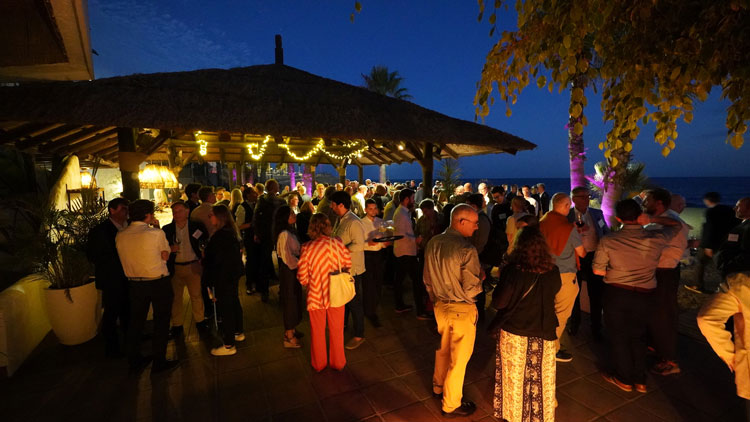
The 2025 Global Photonics Econonic Forum was held earlier this month in Malaga, Spain. courtesy of Andreas Thoss.
Andalusia’s emerging tech ecosystem
Málaga proved to be more than a pleasant backdrop. Spain’s southern region has quietly become one of Europe’s liveliest tech clusters, with Málaga TechPark at its core. The Spanish government recently committed €500 million to build a center for photonic integrated circuits, managed by Belgium’s imec. The move positions Andalusia as a European bridge between photonics research, semiconductor manufacturing, and the rapidly expanding AI hardware economy.
Opportunities and obstacles
The tone in Málaga was cautiously optimistic. Photonics is enjoying renewed attention thanks to its potential to relieve the AI energy bottleneck — the looming constraint created by data-center power consumption. “Semiconductor companies like NVIDIA and TSMC are calling for help,” Voelkel said. “Photonic integrated circuits and co-packaged optics could dramatically increase speed and reduce energy use.”
Yet Voelkel also pointed to structural challenges, including tariffs, supply-chain instability, and the lack of universal standards. “The semiconductor industry scaled through agreed standards,” he said. “Photonics hasn’t reached that level of alignment yet.”
AI acceleration and a $7T investment wave
Few talks generated more buzz than the presentation from Abhijit Mahindroo, a senior partner at McKinsey & Company. Mahindroo referenced Thomas Friedman, who in the 1990s authored
The World is Flat. The text referred to the ease of global trade after the Berlin Wall came down. The world isn’t so “flat” anymore, it seems; and Mahindroos’s talk explored this theme.
On the other hand, the “age of intelligence” is replacing the “age of connectivity.” Using the iPhone’s 18-year innovation cycle as a benchmark, Mahindroo traced how consistent and sustained annual progress turned a consumer device into a 10-million-fold performance leap — and how that device’s supply chain evolved for something like 37 million first-weekend sales.
Today, Mahindroo sees AI infrastructure evolving at least this fast. AI output has made remarkable progress within the last three years. If the same rate of advancement continues, Mahindroo expects a $7 trillion private-sector investment in AI-related hardware, data centers, and power infrastructure over the next five-to-seven years. That equates to about 7x the scale of investment into total internet infrastructure from 1996 to 2001, or China’s Belt and Road initiative, he found. Most remarkably, the funding for AI won’t come from governments but from the balance sheets of the world’s most profitable corporations.
To sustain that pace, Mahindroo said, AI must design the next generation of AI, automating every step from materials discovery to manufacturing optimization. The message resonated strongly with an audience that hopes to benefit from its hardware requirements.
AI-materials loop: Rethinking R&D
Vincent “Chuck” Mattera, longtime industry leader and former CEO of Coherent Corp., mentioned this theme early, on the Forum’s first day. He called for a closed AI loop: “I believe that it's time to adopt AI systems capable of closing the loop between materials, design, and processes,” Mattera said.
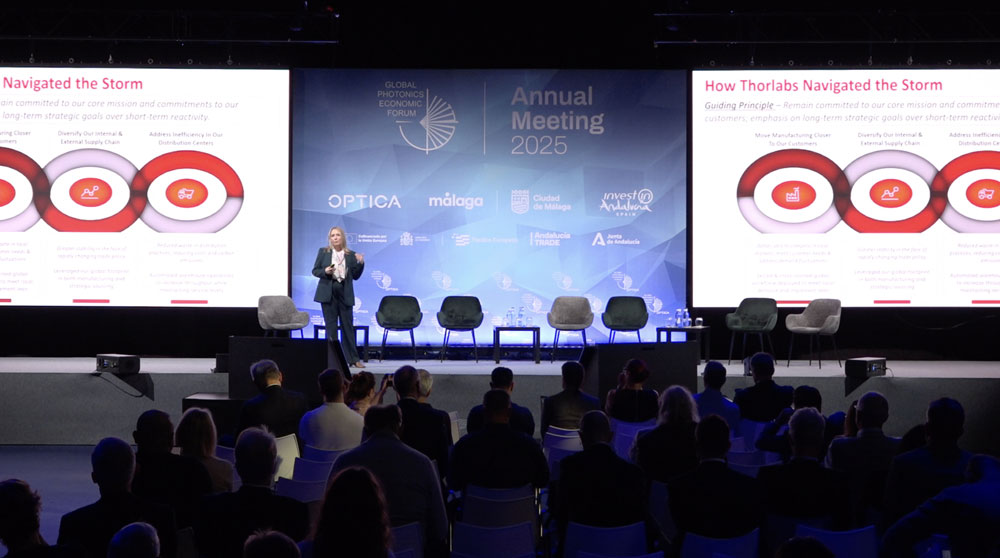
Thorlabs' president Jennifer Cable speaks at the 2025 Global Photonics Economic Forum. Courtesy of Andreas Thoss.
Mattera thinks that this would cut time and investments by half. Predictions for water and electricity consumption by 2030 might force such engagement. “[That,] and educating a 10,000 new engineering and scientist workforce [whose members] are bound to take it to another level” Mattera went on.
Members of a panel, which included officers from Global Foundries, AMD, and others, left little doubt about how hard they are working to bring photonics into large scale applications. Certainly, this will be a field for large scale manufacturers.
Company playbooks: Leadership and culture
Executives from both privately held and public firms shared how they are navigating the shifting landscape. Marisa Edmund (Edmund Optics) and Jennifer Cable (Thorlabs) described how family ownership helps maintain long-term strategy despite market volatility. Mark Gitin of IPG Photonics discussed moving from a founder-driven to a team-driven culture. nLIGHT’s Scott Keeney offered a frank look at supply-chain realignment and what “decoupling from China” actually means at board level.
More social and technical trends
JENOPTIK’s Stefan Traeger encouraged the industry to make photonics more visible to the public, investors, and policymakers. Photonics underpins communication, healthcare, and defense, he said. But we need to tell that story more effectively.
Also, Traeger acknowledged that the attendees traveled mainly from Europe and North America. “That is something we can work on, to bring the Global Photonics Economic Forum really to the world and include people from Asia, from all parts of the world.” It was a reminder that, despite global challenges, photonics remains one of the few industries simultaneously addressing digitalization, sustainability, and security.
Recognition for innovation and impact
Innovation also took center stage in the presentation of the Optica i4 Prize. The prestigious award program honors those who exemplify Optica’s core values — technological innovation, integrity, inclusivity, and impact, as well as perseverance, business and technology foresight, and visionary leadership.
The 2025 Corporate Achievement award went to Corning Inc., which earned recognition for 175 years of optical breakthroughs, from the Hubble Telescope to Gorilla Glass, and the ultra-low-loss fibers that enable not only global data exchange but also future photonic quantum networks.
The Individual Achievement award recognized John T. C. Lee, president and CEO of MKS Inc., which has advanced “from a single market instrument provider to a multi-market powerhouse,” as laudator Ulrike Fuchs said. James Kafka, Optica’s president, and a longtime employee of MKS, highlighted Lee’s internal President’s Technology Innovation Grant program as a model for cross-divisional R&D funding that accelerates real-world impact.
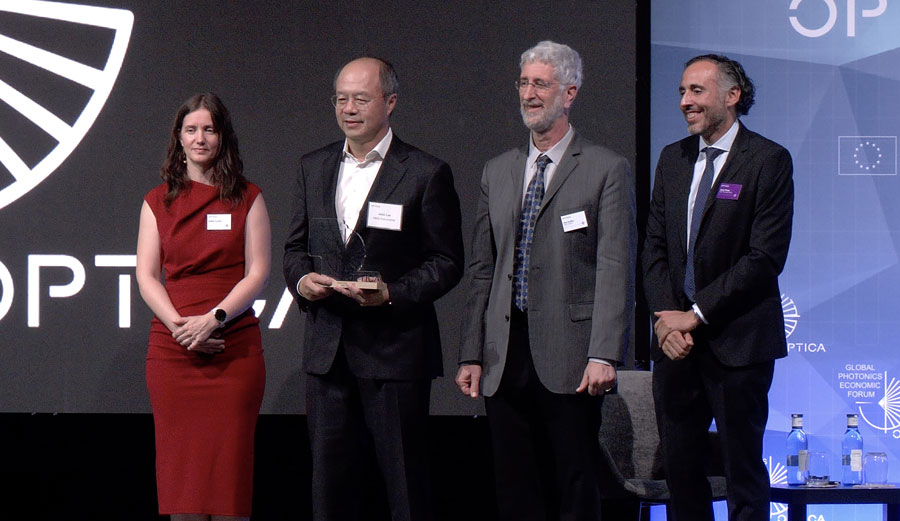
MKS Inc. president, John T. C. Lee (second from left), is recognized as part of Optica's i4 awards program. He stands with members of Optica leadership Ulrike Fuchs (left), James Kafka (second from right) and Jose Pozo. Courtesy of Andreas Thoss.
From discussion to connection
Two evening receptions — both set in splendid beachfront restaurants and one more in Málaga’s historic old town — offered a change of pace from the day’s intense sessions. Under palm trees and the sound of the Mediterranean surf, conversations that began on stage continued over tapas and local wines. The formality of panels gave way to genuine exchange beyond competition and new partnerships quietly took shape. Many participants agreed that this mix of openness and strategic depth is what makes the GPEF unique — an event where business insights turn into personal trust.
A forward-looking industry
Looking at the program in Málaga from a week’s distance, it appears as if photonics is moving from its role as an enabling technology to a strategic industry in its own right. From AI supporting infrastructure to vertically integrated manufacturing and secure global supply chains, companies are betting on light to power the next wave of intelligent infrastructure. As the evening breeze drifted off the sea and the lights of Málaga shimmered across the water, attendees seemed united in one thought: They weren’t merely observing transformation; they were helping to shape it.
th@thoss-media.de