Full company details
SPIE
 The International Society for Optics and Photonics
1000 20th St.
PO Box 10
Bellingham, WA 98227-0010
United States
Phone: +1 360-676-3290
Fax: +1 360-647-1445
Noninvasive Imaging of 3D Chaotic Microcavities
Photonics.com
Nov 2025BELLINGHAM, Wash., Nov. 24, 2025 — Microcavities play a crucial role in technologies ranging from lasers to sensors. These microscopic resonators trap light, allowing it to circulate millions of times within their boundaries. When they're perfectly shaped, the light moves in smooth, circular paths. When their symmetry is disturbed, even slightly, the light behaves unpredictably, following chaotic routes that can lead to surprising effects like one-way laser emission, or stronger light-matter interactions.
Until now, most research on this chaotic behavior has focused on flat, 2D microcavities. These are easier to study because their shape can be seen and measured under a microscope. But truly 3D microcavities — where deformation occurs in all directions — have largely remained unexplored. Their internal geometry is difficult to capture without cutting or damaging the sample, making it difficult to understand how light behaves inside them.
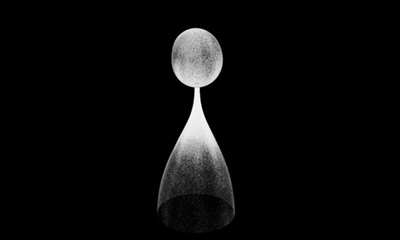
3D X-ray microtomography reveals the internal geometry of a deformed microsphere, allowing insight into chaotic light dynamics. Courtesy of SPIE.
Recent work from an international team of researchers has shown a way to image and analyze 3D chaotic microcavities without harming them. The team used X-ray microcomputed tomography, a technique commonly found in medical and materials science labs, to scan a slightly deformed silica microsphere. This allowed them to reconstruct its full 3D shape with submicron precision.
With this detailed model, the team could calculate how light travels through the deformed cavity. They found that when the shape is distorted in multiple directions, light doesn't just bounce around randomly — it spreads throughout the entire cavity in a process known as Arnold diffusion. this confirms a long-standing theoretical prediction about 3D chaotic light dynamics.
“This work opens a new window for exploring 3D wave chaos, nonlinear optics, and quantum photonics. Beyond fundamental studies, the approach could inspire new designs for high-sensitivity sensors, broadband microlasers, and complex optical networks that harness chaotic dynamics for enhanced performance,” said corresponding author Síle Nic Chormaic, a professor at the Okinawa Institute of Science and Technology.
The ability to measure and predict light behavior in these complex structures opens new possibilities for both fundamental science and practical applications.
This research was published in
Advanced Photonics Nexus (
www.doi.org/10.1117/1.APN.4.6.066006).