Full company details
Balluff Inc.
 8125 Holton Dr.
Florence, KY 41042
United States
Phone: +1 859-727-2200
Toll-free: +1 800-543-8390
Choosing Between Monochrome, Color, and Specialty Cameras
Vision Spectra
Autumn 2025Camera selection depends on the nature of the object being inspected, the desired sensitivity and resolution, and the required level of detail in industrial applications.Alex Conradi, Balluff
In today’s production landscape, industrial image processing is a proven and trusted procedure, serving as a cornerstone of inspection and quality control in modern manufacturing due to its precision and efficiency. Although factors such as lighting, optics, and resolution still require careful consideration for specific applications, the fundamental capabilities of machine vision are well established and validated. That said, industrial camera applications vary widely, and a key decision is whether to use a color or monochrome camera to capture the necessary images, or to apply newer technologies for specialized applications. Each camera type has its own advantages and disadvantages.
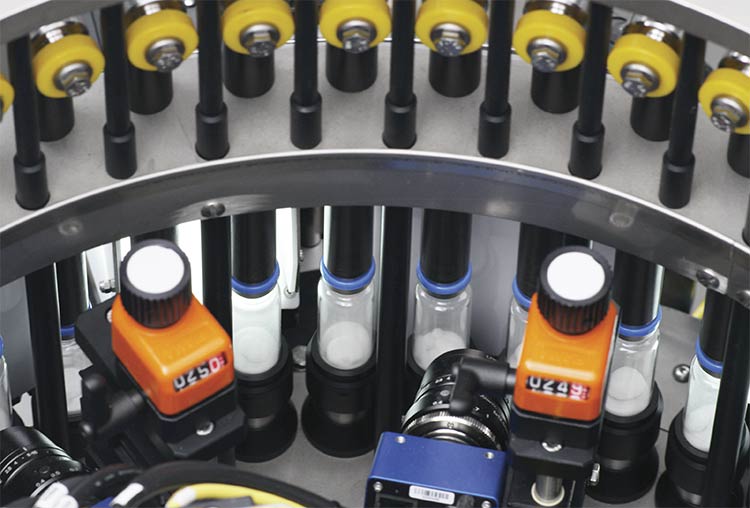
Cameras play an important role in many pharmaceutical applications. Courtesy of Bonfiglioli Engineering.
Machine vision cameras are specialized devices designed to capture images for analysis and processing in a range of industrial applications. Like other industrial tools, they come in various types tailored to specific needs. During the past five years, the manufacturing industry has undergone a significant transformation, driven by automation, artificial intelligence, and the growth of smart factories. Vision systems have played a central role in this progress, enabling real-time quality control, predictive maintenance, and adaptive process optimization that were not previously attainable. Industrial imaging is now widely used across sectors — including automotive, electronics, pharmaceuticals, food processing, packaging, and textiles — with applications that vary widely. For example, vision systems can be used to verify solder joint integrity in circuit boards, inspect fill levels in bottling plants, and sort agricultural produce by ripeness.
In simple terms, monochrome cameras capture black-and-white images with higher sensitivity and resolution — useful in applications such as component inspection — while color cameras use filters to capture full-color images for color-based analysis, such as assembly verification. Specialty cameras are also available for unique applications, such as capturing details invisible to the human eye.
As vision systems become more intelligent and versatile, the choice between monochrome and color cameras is increasingly determined by the specific application. While monochrome cameras remain dominant in tasks requiring high resolution and sensitivity — especially in embedded vision — recent advancements in technology have improved the performance of color cameras. Advancements in techniques such as bilinear or nearest-neighbor interpolation, which use known colors to fill in color gaps, have made color cameras more useful in complex inspections — especially those where an object’s color and/or appearance is essential.

Designed for semiconductor environments, the monochrome camera enables high-precision inspection of wafers to detect surface defects, particles, and structural inconsistencies — ensuring quality control at every stage of the production process. Courtesy of Balluff.
A comparison of the advantages and disadvantages of each type of camera includes specifications such as cost, capabilities, range, and resolution, as well as options for applications that require imaging beyond the standard scope.
Monochrome cameras
Monochrome cameras capture images in grayscale, measuring the intensity of light without using color. Because they can detect the entire visible spectrum, they deliver higher light sensitivity and offer better resolution than color cameras with the same sensor technology. These cameras are particularly effective in environments where contrast is paramount, such as inspecting printed circuit boards or detecting surface defects on metal parts.
Monochrome cameras do not require a color filter array, allowing more light per pixel; they offer higher spatial resolution for the same sensor size and are ideal for contrast- or shape-based inspection.
Applications for monochrome
cameras:
•
Defect detection: These cameras detect subtle defects in manufacturing processes, such as scratches, cracks, and inconsistencies in shape and texture. They capture fine details and variations in light intensity, which is especially important in semiconductor and metrology applications.
•
Low-light environments: These cameras perform well in low-light conditions such as underground mining, warehouse automation, night vision, and astronomy, due to a high signal-to-noise ratio (SNR). High SNR is also critical for high-speed image acquisition.
•
Surface inspection and optical character recognition (OCR): These cameras excel in applications such as scratch or dent detection, print quality checking, and OCR, as these tasks rely on contrast rather than color, offering improved edge detection and enhanced contrast.
•
Infrared imaging: These cameras work effectively with infrared (IR) illumination to see through materials such as plastics or coatings. They are ideal for tasks such as package seal verification and nondestructive testing, which rely on detecting features invisible to the human eye.
•
Tooling inspection: These cameras are preferred for inspecting precision instruments due to superior image quality, high light sensitivity, and excellent contrast. They are ideal for tooling inspection applications at companies that manufacture tooling presetters, inspection equipment, and similar instruments.
Color cameras
In contrast, color cameras capture full-color images using a Bayer pattern filter.
The Bayer pattern is a color filter array used in most single-chip digital image sensors. It consists of a grid of red, green, and blue filters placed over the image sensor array, which allows the camera to define the color. This is essential for applications that require color differentiation. However, it results in a loss in resolution because some pixels must be extrapolated to generate accurate colors.
These cameras detect color variations and defects, making them useful for product sorting, labeling, and
cosmetic inspections. However, they offer lower resolution than monochrome cameras, which is why they
are not used in the same application areas.
Applications for color cameras:
•
Sorting by color: These cameras are essential in industries such as food and beverage, automotive, recycling, agriculture, and textiles to sort items based on hue, saturation, or RGB values.
•
Cosmetic inspection: These cameras are ideal for detecting discoloration, paint defects, and surface inconsistencies — especially those that are difficult to detect with the human eye. They are commonly used in industries where visual appeal is vital, such as pharmaceuticals, consumer electronics, and automotive manufacturing.
•
Assembly verification: These cameras are useful in multipart assembly to confirm the presence and proper placement of components, especially those that are color-coded.
There are several key considerations when choosing between color and monochrome cameras, and they
must be carefully weighed, based on the user’s needs and the intended
application.
Of course, cost is a major factor. Users must consider the total cost of ownership, including upfront costs, maintenance, image processing software, and any additional equipment needs. It is also important to evaluate how the camera choice will affect productivity, efficiency, and long-term return on investment.
If an application can be solved with a monochrome camera, it may be the best choice. Monochrome cameras are generally simpler and more economical. Color systems often require additional processing power for color balancing and interpolation, which increases bandwidth demands.
Lighting conditions are also an important factor in camera selection. Users should assess the typical lighting in the application area. Monochromatic cameras generally perform better
in low-light environments, while color cameras may struggle with color
fidelity under certain types of artificial lighting.


A 42 Technology machine demonstrator replicates a machine function using Balluff’s high-performance image acquisition system, Arcturus’ deep-learning models, and the Synaptics Astra SL1680 edge AI processor. Courtesy of 42 Technology.
The required image quality for the application should be considered. Those evaluating different camera types should assess the level of detail needed for a particular application. Higher-resolution cameras provide greater detail, which is crucial for tasks such as quality inspection and detailed scientific analysis. Monochrome cameras are ideal for geometry or texture checks. If color information is vital to an application and involves three or more colors, manufacturers recommend using a color camera. However, for distinguishing between just two colors, a monochrome camera with a filter is the better choice.
Finally, post-processing requirements are an essential part of the equation. Users should determine how the images will be used, stored, and shared. High-resolution and color images require more storage and bandwidth
for transfer, though color images can be easier for human inspectors to interpret.
Specialized imaging options
For some vision applications, the best solution is not limited to color or monochrome cameras. Near-infrared (NIR), infrared, and shortwave infrared (SWIR) cameras provide specialized imaging capabilities that other cameras cannot offer. These cameras can capture image details beyond the visible spectrum, revealing features invisible to the human eye. UV cameras use ultraviolet light (200 to 400 nm), while SWIR cameras operate in the shortwave infrared range (900 to 1700 nm).
These advanced imaging technologies are ideal for more difficult applications such as inspecting through silicon wafers, measuring product levels within opaque plastics, verifying paint thickness, detecting moisture in packaging, revealing contamination or bruising in agricultural produce, and monitoring thermal behavior in materials and machinery.
In recent years, many industries have adopted specialized industrial vision systems. SWIR, in particular, has proved to be valuable for applications that require the detection of features invisible to visible light. However, these specialized cameras come at a significantly higher cost. While standard monochrome and color industrial cameras typically range from $100 to $1500, NIR cameras cost between $500 and $5000. SWIR systems, often built with expensive indium gallium arsenide (InGaAs) sensors, typically start at $5000 and can exceed $50,000. Despite the cost, the unique advantages of these technologies are driving their adoption across sectors that demand precision and spectral sensitivity.
Additional costs may arise from specialized add-on components needed to tailor the camera to the application. Users may need to select specific lenses made from infrared-transmissive materials to meet wavelength requirements. Spectral filters are required to isolate desired spectral bands for enhanced analysis. In demanding environments, rugged enclosures or temperature-controlled casings may be necessary to protect the camera and maintain performance. Additionally, specialized software may be required.

A comparison of the advantages and disadvantages of monochrome and color cameras, depending on the intended application. Courtesy of Balluff.
In today’s evolving production environment, camera selection has become increasingly application-specific, with users often opting for hybrid systems that combine monochrome, color, and specialty cameras based on the inspection or analysis requirements. Systems can be tailored to specific production lines and offer greater versatility. While ongoing advancements continue to expand vision system options, many traditional applications still rely on the tried-and-true imaging types — such as monochrome cameras for barcode reading and color cameras for product labeling.
In summary, camera choice depends more on the objective than the budget. Users should consider the details they need to capture and the purpose of the inspection task.
Meet the author
Alex Conradi is a technical sales engineer for Balluff Americas, focusing on custom design and engineering with an emphasis on industrial cameras and automation. He earned a Bachelor of Mechanical Engineering from the University of Louisville and holds an MBA from the University of Colorado Denver; email:
alexander.conradi@balluff.com.