The world has changed a lot in 2025. Tariffs came and (some) went away, the AI boom seems to be persistent, and Europe turned its mind on defense. At the end of this amazing year, contributing editor and photonics writer Andreas Thoss shares his thoughts on current and upcoming trends in photonics markets.
BY ANDREAS THOSS, CONTRIBUTING EDITOR
When Bob Dylan wrote the iconic song “The Times They Are A-Changin’” he was protesting the Vietnam War. I don’t know what he thinks about today’s wars, but times have changed substantially. Today Vietnam has become a dynamic industrial marketplace, and the U.S. has redefined its own role in the world. Europeans, meanwhile, are staring at the war in Ukraine and hastily increasing their defense budgets. At the same time, it looks as if we all are facing a technological revolution coming from artificial intelligence.
The effects of these trends are not clear yet. It turns out that change itself is the biggest trend at the moment, and it is coming rapidly and in many fields. It has already caused widespread uncertainty. And it is opening new opportunities.
Photonics for AI
Artificial intelligence is a trend that surprised me by not changing. Many people thought the bubble would burst in October or November; it didn’t. The trend persists, and most people I’ve spoken with see it as the most relevant technology for the near future.
What does that mean for photonics?
I see three things:
1. The hunger for more and faster chips remains steady. AI (and home-shoring) is leading to an upswing in investments in the semiconductor industry. Therefore, all companies that deliver into that supply chain could have a good year 2026. This is backed by data from SEMI: “Global semiconductor equipment sales show robust momentum, with both the front-end and back-end segments projected to see three consecutive years of growth, culminating in total sales surpassing $150 billion for the first time in 2027,” said Ajit Manocha, SEMI president and CEO, in a press release on Dec. 15, 2025.
2. AI will change the way we work. For more details on this, you may refer to my feature on “AI in photonics” — which will be published in the “Trends” edition of Photonics Spectra in January 2026. First, AI will boost automation by supporting image recognition in quality control. More importantly, it may help to simulate production processes, which would allow groups to establish closed-loop control of many production processes. That is the holy grail of process control! Imagine a self-controlling welding machine that changes laser parameters as needed to stay in a defined process window.
3. Photonics will expand deeper into data centers. NVIDIA announced the launch of “Spectrum-X Photonics Switches” at its GPU Technology Conference (GTC) in March 2025. Such a switch transmits up to 800 GB/s per port. Its total bandwidth ranges from 100 to 400 TB/s, depending on the number of ports. The switch could be made available in 2026.
But a photonic switch is just the next level. The actual breakthrough would be a full photonic processor. German startup Q.ANT has announced just that; In 2025 the company received €68 million ($80.1 million) in Series A capital. Q.ANT is now working along its aggressive roadmap to beat NVIDIA’s processors in a few years. Its photonic processor is said to need 90x less energy for computing — addressing the biggest bottleneck of AI.

Figure 1. Q.ANT founder and CEO Michael Förtsch holds the company’s commercial photonic processor, designed for real-world AI and high-performance computing workloads. Courtesy of Q.ANT.
Of course, photonic interconnects and computers serve the larger trend of integrated photonics and co-packaged optics. This has been touted for years, and it will take more time and effort for industry to build it as big as market prognoses have told us for some time already. There are a lot of open questions (involving standards, materials, and scaling. But the prospects of photonics in data centers are better than ever.
Laser market growth
Looking at the laser markets, it is clear there are more lasers coming from China. But let us look at the global market first.
I spoke with Arnold Mayer from Optech Consulting about the market for laser material processing systems. “It was a good year,” Mayer said. “The global market reached a new all-time high of [$24] billion in 2025.” Optech Consulting expects an increase of 5% to 7% versus 2024, based on the data available in December 2025.
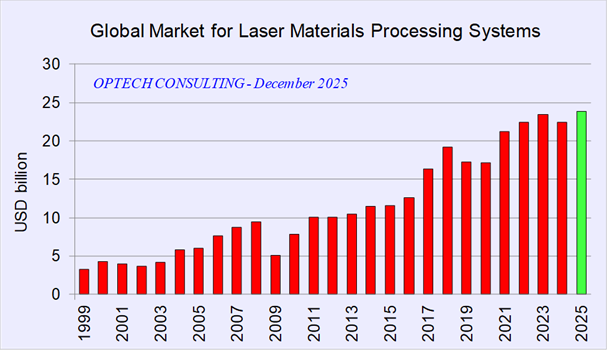
Figure 1. The global market for laser material processing systems marks a new all-time high in 2025. Courtesy of Optech Consulting.
Market growth in 2025 was spurred by microprocessing applications in the semiconductor, flat panel display, and circuit board industry, with especially strong equipment investments in China. “Furthermore, the demand for laser equipment in [electric vehicle] battery manufacturing equipment recovered in 2025 from the decrease in the year before” Mayer added.
Despite overall market growth, 2025 was not an easy year for laser system manufacturers in North America and Europe. The weakness of the cutting systems market extended from 2024 into 2025. What makes things worse (for Westerners): Imports from China are increasing at the same time. The Chinese trade excess for laser machine tools increased six-fold in the last five years and approaches $1.5 billion this year.
“Over the years, Chinese manufacturers of high-power laser systems have steadily captured a dominating share of the domestic market. Building on this foundation, they are now expanding into the global market with increasing competitiveness and scale, and offering advanced solutions that challenge established international players,” said Bo Gu, president and CEO of BOS Photonics, and an expert with deep knowledge of the Chinese market.
The same can be seen in the development of major Western companies: Laser-maker IPG Photonics, for example, reports consistently decreasing market shares. In its SEC Report 10-K 2024, the company said, “A significant portion of our sales are to customers in China, which accounted for 25%, 28%, and 34% of net sales in 2024, 2023 and 2022, respectively.”
Lasers for material processing have matured. The markets are growing, but Chinese companies have secured more of their domestic markets and are starting to push their exports more aggressively.
Lasers in defense
It was one of the first arguments to drive laser developments in the 1960s: They (lasers) could become the next big thing in defense (after the nukes). Expectations exceeded reality by far. Lasers needed 50 years to make it from comic books to the battlefield. Now, they have arrived.
In May, Israeli defense company Rafael reported the first laser test in combat. Laser systems for air defense have been shown at trade shows for years already, but this was confirmation of a deployment in a real war. More tests have been completed, and in September Rafael announced that its Iron Beam 450 high-energy laser weapon (Elbit Systems delivered the 100-kW laser source) will be integrated into Israeli air defense by the end of 2025.
News of similar systems came from China, the U.K., Germany, and the U.S. Even German laser maker TRUMPF published a partnership (with Munich’s Rohde & Schwarz) to build a defensive laser weapon. This is remarkable since the ethical codex of TRUMPF’s owner family excluded such activities until now. This can be seen as part of a groundbreaking change in European (and particularly German) thinking: After Russia’s invasion in Ukraine, a war in Europe has become a serious consideration. Eighty years after the end of World War 2, defense (and only defense) became an urgent priority with hundreds of billions of tax money allocated for investments in 2025.
Beyond governmental funding, we might see a change in private investments, too. Again, there is a big shift in ethics. So far, many European funds have been prohibited from investing in defense companies. Reuters, in November, reported, “Norway could allow its $2.1 trillion sovereign wealth fund, the world's largest, to invest in major [defense] companies from 2027 after a more than 20-year hiatus.” European research organizations face similar discussions.
For the laser market, it is hard to estimate the effects. Certainly, laser weapons will become a regular product. Similar to laser communication terminals for satellites, it will be a product in the portfolios of a few specialized providers. Investment in basic units will be significant; the lifetime(s) of these systems has not yet been shown. The returns may increase further after a wider market introduction, and sales prices may drop if unit numbers increase. Will it become a significant market? Investments have already begun, so I guess we will find out soon. For sure, it will be a topic to watch throughout 2026, and before we welcome in 2027, we may even be able to crunch the first market numbers.
The year 2025 has been one of many changes. Accordingly, predictions for the next year are even more difficult than in other years. Personally, I hope that we see peace in Ukraine. Far too many people have died there. I hope that the tempers in international trade calm down and that the exchange within the global laser community grows again. Laser technology has matured in many fields, which allows for more applications. And new developments, such as photonic computing, are very exciting. So we live in exciting times and hope for the best.
th@thoss-media.de