
Test and Measurement Breakthroughs Bring Optical Quantum Experiments Under Control
Innovations in the photonics test and measurement sector are needed to ensure that increasingly sophisticated quantum technologies reach their target applications.
By Jason Ball
For all of its promise — including ultrasecure communications, exponential computing speedup, and unprecedented precision in sensing and measurement — quantum technology presents numerous dynamic challenges. Though the complex nature of quantum’s algorithmic and scientific requirements is well understood, implementing even the most mature quantum technologies demands significant time, labor, and resources. Even now, more than 100 years since Einstein posited the particle-like nature of light, the scientific community continues to grapple with fundamental barriers to implementation, such as noise, scalability, and entropy.
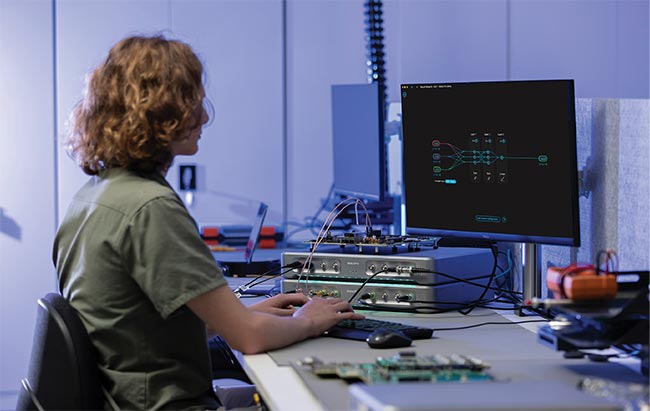
Courtesy of Liquid Instruments.
Against this backdrop, overall progress in quantum technology maintains a slow but steady course. Quantum researchers are leading the charge to push the limits of current laboratory technology.
At the same time, the role of quantum information science for industry and
society is already vast. Quantum computers built on atomic arrays, for example, are poised to exponentially speed up the calculation times for certain types of problems that are difficult for classical computers. Concepts such as entanglement and superposition can help achieve more precise electromagnetic and gravitational field sensing for users in the field, as well as improved results from superresolution imaging in laboratory settings. Quantum key distribution (QKD) techniques using optical carrier frequencies can also transmit information that is extremely difficult to intercept, supporting ultrasecure data and telecommunications. Many additional applications are already in practice. Others are on the way.
Demands for quantum optics call for devices that can precisely control qubit states. These devices must also provide sequencing capabilities responding to qubit state information in real time. Courtesy of Stock.com/da-kuk.
Continued progress in these applications and the emergence of those on the horizon is not a guarantee. To ensure future gains, the photonics test and measurement sector must itself evolve to address the technical challenges posed by distinct quantum applications such as sensing, computing, and cryptography. Advancements in measurement precision — resulting in reduced noise floors and increased sampling speeds — as well as the introduction of flexible hardware platforms such as field-programmable gate arrays (FPGAs), are critical to meeting these challenges. It is also essential for manufacturers of these test and measurement instruments to develop streamlined and scalable processes, ultimately making it easier for end users to adapt to changes in scope or requirements.
Optical quantum systems
Optical quantum systems offer a range of desirable characteristics, making these systems attractive options for quantum sensing, computing, and cryptography. These systems often use atomic energy levels to represent classical 0 and 1 states, and the indistinguishability of atoms means that any two of a certain species will be identical in structure. For this reason, atoms have earned a reputation as “nature’s perfect qubit.” Opportunities abound to harness quantum mechanics in the domain of atomic, molecular, and optical physics.
Given their higher transition energies, optical systems are also stable at room temperature and do not require large-scale cryogenics or dilution refrigerators for operation. This stability means that optical frequencies are well suited for the transmission of quantum state information over long distances. Atoms can also be packed in dense formations, which is an advantageous quality for scalable quantum computing. Importantly, atoms benefit from a well-established photonics infrastructure that comprises many manufacturers of lasers, optical components, and test and measurement equipment.
Technical challenges in quantum optics
The cutting-edge technologies that are driving progress in quantum sensing, compute, and cryptography face several challenges. An ion trap, for example, has widespread potential for use in quantum chemistry, metrology, and sensing1. But experiments involving these devices have many moving parts.
An ion trap consists of 1D or 2D arrays of ionized atomic nuclei. Researchers must tightly control and synchronize an array of lasers, maintain direct current and radio frequency fields, and continuously check for the presence of ions in the trap via fluorescence measurements. These requirements place stringent demands on the control electronics, necessitating devices that can quickly and precisely control qubit states, both for single-qubit and two-qubit gates, and provide agile sequencing capabilities that respond to qubit state information in real time.
An active reset, where a user checks if a qubit is initialized into the quantum ground state, creates another technical bottleneck. There is no action for the user to take if the qubit is measured to be in the 0 state. But, if the qubit is in the 1 state, the user will need to return it to the ground state through a laser pulse. Also, to ensure that the user obtains any benefit from the reset, the sequence must take place on a scale faster than the qubit’s coherence time.
Stabilizing multiple concurrent laser beams is also a technical challenge since these optical setups are extremely sensitive to external noise. Again, this approach requires electronics that can provide active, real-time feedback.
Quantum communication protocols, such as BB84, present challenges, too. Signal integrity becomes a concern when transmitting over long distances, limiting the scale to which current networks can operate. The detection of signals must also be rapid and precise, so that QKD protocols can be verified in real time.
The hub of the measurement
To address these demands, industry is pioneering solutions at both component and system level. Detectors such as lock-in amplifiers offer low input noise for extracting weak signals from noisy backgrounds, and frequency- and event-counting modules provide highly efficient time-tagging and coincidence counting for fluorescence detection and QKD validation. Meanwhile, signal generators
are rapidly increasing in sampling rate, meaning that they can synthesize frequencies in both the radio frequency and microwave domains. This eliminates the need for separate electronics.
The resulting increase in time resolution also enables more precise timing of laser pulses and improved qubit manipulation. Automated control loops and hardware for the stabilization of lasers and frequency combs are also evolving, benefitting from recent advancements in machine learning. These algorithms can help eliminate much of the guesswork and time loss involved in tuning proportional-integral-derivative loops. Additionally, many of these improved hardware solutions also feature efficient software integration. This allows users to deploy new technologies in their experiments without excessive delays or a reduction in productivity.
Other breakthroughs in test and measurement technology are helping to meet the multifaceted technical challenges posed by quantum systems. The proliferation of FPGAs is one such trend. These integrated circuits are rapidly gaining traction as the first choice for a variety of quantum technology applications.
Parallel processing capabilities, which enable FPGAs to perform the same functions as a CPU with lower power consumption and deterministic temporal behavior, are among their most enticing features. This, in turn, enables rapid response times, eliminates the need to communicate with a host PC, and provides large data handling capabilities — all essential for data-heavy tasks such as QKD postprocessing.
The reconfigurable nature of FPGAs also means that they can be customized to perform different functions across a wide range of quantum systems and experiments. For example, an FPGA can operate as a signal source, detector, or signal processor. While the relatively low sampling rate of FPGAs has historically been a barrier to direct signal generation, FPGAs on the market today achieve speeds that are sufficient for many applications.
For other quantum applications, such as those requiring microwave frequencies of up to 10 GHz, the FPGA can accomplish this through image frequency generation in higher Nyquist zones or through heterodyne mixing. Because they can both generate and process signals in real time, FPGAs excel as the “hub” of the measurement, improving speed and reliability. Moreover, they make excellent choices for active feedback due to their low latency and responsiveness, enabling their operation within a qubit’s decoherence time.
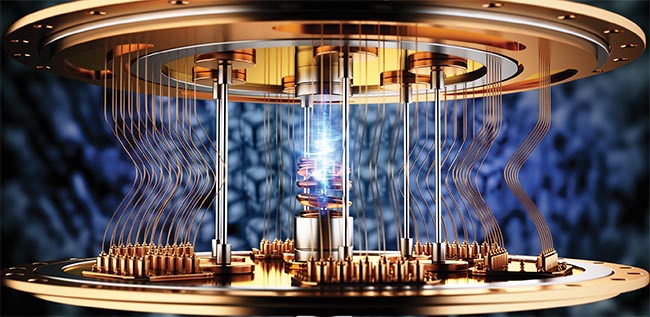
Quantum computing is emerging as a promising field for advancing atomic energy research. These systems use qubits, which can exist in a superposition of 0 and 1 simultaneously. Courtesy of Stock.com/adventtr.
These benefits offer strong motivations for incorporating FPGAs into commercial solutions — such as those from companies such as Liquid Instruments and
others — as well as open source projects.
These devices typically implement custom firmware to streamline functions such as generating pulse sequences, setting the frequency and phase of the local oscillator, and demodulating readout data for the end user. Certain devices even allow users to directly implement FPGA code for their own unique functionality.
Of course, challenges to the use of FPGAs persist even as adoption increases. For example, many users struggle with programming FPGAs, particularly the large number of physicists with a lack of direct experience. For this reason, numerous projects seek to make the technology more accessible to a wider audience.
Quantum and machine learning
The intersection of quantum technology and machine learning, particularly artificial neural networks (ANNs), is another catalyst for growth in quantum technologies. ANNs consist of interconnected
layers of artificial neurons, with a nonlinear function operating on a weighted linear combination of the previous layer to determine the values of the next layer. The weights applied to these individual neurons are at first randomly generated and become more refined as training data passes through. The result is checked against a cost function. This function is then minimized by adjusting the weights and biases of the network through a process called backpropagation.
ANNs have tremendous utility in predictive modeling and identifying correlations in large data sets. It is easy to see why ANNs hold conisderable appeal for quantum researchers. Yet amid growing interest in whether quantum algorithms can reduce the training time and energy consumption of deep learning models, this claim remains the subject of intense debate.
Evolving test and measurement equipment, systems, and protocols are helping to resolve the complex technical challenges that quantum systems present. Field-programmable gate arrays (FPGAs) are among the most promising technology solutions for addressing these and future challenges. Courtesy of iStock.com/PhonlamaiPhoto.
What is clear, though, is that machine learning is already bolstering quantum technology. Machine learning algorithms are very efficient at data processing, which is a trend that readily extends to the quantum space. Demonstrations have also revealed that these algorithms can infer quantum states without full information, leading to more rapid readout and, potentially, improved fidelity. Machine learning algorithms can also improve experimental protocols and feedback strategies, and may even suggest new techniques.
Another benefit is that these types of neural networks avoid consuming large amounts of CPU or GPU processing power, in contrast to the massive computational and training requirements of generative AI and/or large language models. In fact, small-scale neural networks can comfortably operate within the confines of FPGA architecture, using parallel processing. In this way, researchers can use the flexibility and low latency that FPGAs offer to implement custom signal analysis, predictive modeling, and active feedback loops via a neural network. By operating in real time within experimental procedures, researchers have used FPGA-based neural networks to diagnose the states of multiple qubits simultaneously, while retaining measurement fidelity.
Future perspectives for quantum optics
Despite the many advanced tools that are currently available, optical quantum information science has traveled a long road to maturity, owing to the intrinsically difficult and sensitive nature of the technology. The road to commercialization for many applications — especially full, error-correct quantum computing — remains years, if not decades, away.
Fortunately, test and measurement equipment continues to grow in sophistication, spurred on by progress in the field at large and its capability to meet increasingly stringent requirements. As is true of quantum research itself, these hardware requirements are constantly evolving and shifting. Dead ends and impractical solutions abound, but only rigorous testing serves to reveal these flaws.
For this reason, researchers and scientists must future-proof their equipment against such changes. By combining powerful hardware, customizable FPGAs, and machine learning, quantum research scientists can ensure that their experiments will meet upcoming challenges with flexibility and speed.
Meet the author
Jason Ball is an engineer at Liquid Instruments, where he focuses on applications in quantum physics — particularly quantum optics, sensing, and computing. He holds a Ph.D. in physics from the Okinawa Institute of Science and Technology; email: jason@liquidinstruments.com.
Reference
1. K. Gilmore et al. (2021). Quantum-enhanced sensing of displacements and electric fields with two-dimensional trapped-ion crystals. Science, Vol. 373, No. 6555, pp. 673-678.
/Buyers-Guide/Liquid-Instruments/c30813