
SAXFUSION Initiative to Advance Germany’s Fusion Energy Road Map
The German State of Saxony is launching a competence network for future technologies in nuclear fusion. The aim is to advance fusion as a clean, safe, and base-load capable energy source, to build strategic expertise, and to make the results available to industry and society. Michael Bussmann’s group of Computational Radiation Physics at Helmholtz-Zentrum Dresden-Rossendorf (HZDR) is coordinating the initiative. The Fraunhofer Institute for Material and Beam Technology IWS (Fraunhofer IWS) is serving as co-lead.
The European Union and the Free State of Saxony are supporting the project with around €2.4 million ($2.8 million) in financing from the European Regional Development Fund.
The network aims to serve as a central point of contact for partners from research, industry, and society who are interested in fusion as a potential research and business area and who require in-depth information on the topic of nuclear fusion. During a three-year development phase, the SAXFUSION team will identify and link existing expertise in Saxony. It will also specifically form collaborations and long-term R&D strategies. The project kicks off with four central areas of expertise: laser and optical technologies; development of fuel capsules including the diagnostics of the fusion reaction; research into reactor materials; and comprehensive simulations and data analyses.
“Our goal is to raise awareness of Saxony’s expertise in this future-oriented industry and to participate in international development projects,” Bussmann said.
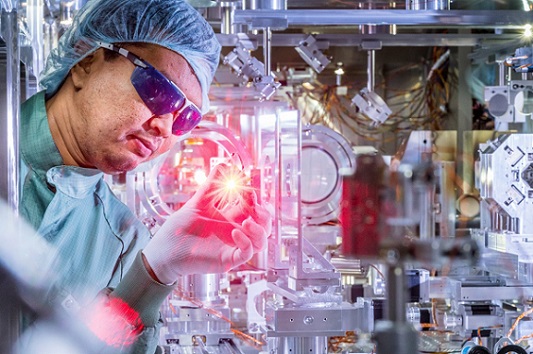
SAXFUSION connects cutting-edge research in Saxony to advance fusion energy. Laser and materials technologies play a key role in future reactor concepts. Courtesy of Fraunhofer IWS via HZDR/Andre Wirsig.
The HZDR has built an international reputation in plasma experiments and material testing, in research with high-power lasers, and in the development of computer simulations and AI for plasma research. Now, the SAXFUSION network builds links to major European research infrastructures such as the European XFEL and the Extreme Light Infrastructure, as well as international fusion research centers such as ITER, Lawrence Livermore National Laboratory, and Wendelstein-7X.
In addition to R&D and academic partners, industry participants on the effort include Amplitude, Marvel Fusion, and Focused Energy. As project co-lead, Fraunhofer IWS will be responsible for transferring the technology into industrial practice.
/Buyers-Guide/Amplitude/c787