
PsiQuantum Raises $1B, Collaborates with NVIDIA
Quantum computing leaders PsiQuantum has raised $1 billion in funding, enabling the company to break ground on utility-scale quantum computing sites in Brisbane, Australia and Chicago. PsiQuantum said the financing also supports the company's planned deployment of large-scale prototype systems to validate systems architecture and integration.
The round values the company at $7 billion, and includes support from NVentures, NVIDIA’s venture capital arm. PsiQuantum's collaboration with NVIDIA now spans multiple development areas, including quantum algorithms and software, GPU-QPU integration and PsiQuantum’s silicon photonics platform.
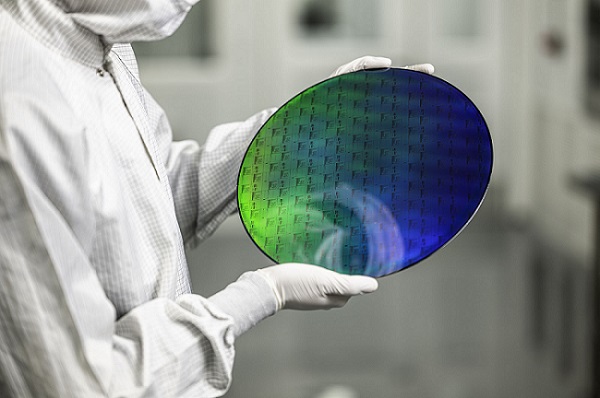
Omega, PsiQuantum’s silicon photonic quantum chipset, designed by PsiQuantum and manufactured at GlobalFoundries’ Fab 8 in New York. Courtesy of PsiQuantum.
Since the company’s series D financing in 2021, PsiQuantum has established a high-volume manufacturing process for its integrated photonic chipset, containing the components needed for photonic quantum computing — all of which perform beyond the state-of-the-art, the company said. The chipset is designed by PsiQuantum and manufactured at GlobalFoundries’ Fab 8 in New York — a high-volume, commercial semiconductor foundry.
Critically, PsiQuantum has integrated barium titanate (BTO) into its manufacturing flow; the electro-optic material it ideally suited for ultra-high-performance optical switches — the missing component for scaling optical quantum computing. PsiQuantum manufactures 300-mm wafers of BTO at its facilities in California, which are then integrated together with wafers manufactured at GlobalFoundries. PsiQuantum's BTO-enabled optical switch also has potential in next-generation AI supercomputers, an area of increased interest given rapidly-growing AI workloads, where low-power, high-speed optical networking is increasingly relevant.
In addition to the photonic chips which generate, manipulate and measure qubits, PsiQuantum also develops the cooling, networking, and control systems for utility-scale machines. The company has designed and commissioned a high-density cooling solution, similar to the modular racks found in a datacenter, with the capacity to cool hundreds of quantum chips in a single cabinet. It has also demonstrated high-fidelity quantum networking between distant cabinets using standard telecom fiber — a key requirement for most approaches to utility-scale quantum computing.
Published: September 2025