By Ivan Nikitskiy
Advancements in photonics are playing a pivotal role in enabling scalable quantum technologies, spanning applications from computing to secure communications and precise sensing. Innovations in low-loss integrated photonics, ultranarrow-linewidth lasers, and chip-based entangled photon sources are among the key areas of advancement. The emergence of such precision light sources, quantum photonic integrated circuits, and ultralow-loss interconnects is addressing critical challenges in the development of quantum systems. This is taking place at a time when industry is working to overcome barriers to quantum commercialization.
As standardization continues to progress and manufacturing scalability improves, photonics is well positioned to become the foundational technology enabling the quantum revolution — much like silicon’s role in classical computing. The rapid market expansion underscores both the technological promise and the economic potential of quantum photonics in the coming decade.
Industry and its innovations
Photons are inherently quantum mechanical and resilient to many forms of environmental noise, two qualities that make them ideal carriers of quantum information. Quantum computing, for example, relies on quantum bits (qubits), which can simultaneously exist in multiple states.
Similarly, in quantum sensing, one common approach involves the manipulation of solid-state color centers, where classical light excites specific transitions and the quantum spin state is inferred via fluorescence detection. Other implementations use cold atoms, squeezed light, and/or superconducting circuits. Across each of these applications, photons enable functionalities that are unattainable by classical systems.

The interior of a laser from Chilas Lasers. Courtesy of Chilas Lasers.
In computing, sensing, and, in fact, all quantum photonics applications, a set of specialized optical components that must meet stringent performance criteria is needed to enable functionality. Narrow-linewidth lasers are a foundational technology in this context; these sources are essential for manipulating quantum states with high precision. They are used in applications including atom trapping, ion manipulation, and precision timekeeping (atomic clocks).
Chilas Lasers is a leader in this space. The Dutch developer of ultranarrow-linewidth, widely tunable laser systems manufactures hybrid integrated lasers that combine silicon photonics with semiconductor optical amplifiers and achieve sub-kilohertz linewidths. These solutions fulfill the demanding requirements of quantum sensing as well as quantum metrology.
Importantly, Chilas’ platform supports scalable manufacturing, making its solutions attractive for both research and commercial quantum systems. Scalability remains the holy grail of quantum computing. Unlike traditional bulk-optics setups, quantum photonic integrated circuits enable miniaturized, stable, chip-scale quantum components that are essential for scalable, and ultimately commercial-grade, systems.
For this reason, the uptick in quantum integrated photonics innovation is both predictable and profound. IMS CHIPS, a German microelectronics research institute, is advancing CMOS-compatible photonic integration platforms tailored for quantum applications. Its process toolkit includes both silicon and silicon nitride photonics, each optimized for different performance trade-offs, such as optical loss, switching speed, and nonlinear response. Additionally, IMS CHIPS is now expanding into thin-film lithium niobate platforms, which industry values for their strong electro-optic properties and low propagation loss. These characteristics are optimal for high-speed quantum modulation and entanglement distribution.
Innovations in distinct photonics technologies and parameters — such as laser stability, photonic integration, ultralow-loss components, and compact entangled photon sources — are already solving critical bottlenecks on the road to scalable quantum systems.
At the same time, a Leibniz University Hannover spinoff, TwinPhotonics, is developing modular photonic systems and interconnects for quantum networks. The company’s platform emphasizes the low-crosstalk and high-coherence signal routing that are needed for multiqubit architectures. With a modular, plug-and-play design approach, TwinPhotonics’ technology supports scalable, reconfigurable photonics subsystems. The company’s solution thus helps to bring quantum processors closer to market-ready form factors.
Another firm, Modulight, a Finnish developer and manufacturer of high-performance semiconductor lasers, is exploring integrated platforms that combine laser diodes with nonlinear materials for on-chip generation of entangled photon pairs. Entanglement is at the heart of quantum communication and distributed quantum computing, and compact, efficient, and integrable sources of entangled photon pairs are essential to power future quantum networks. Combining vertically integrated manufacturing and the company’s expertise in monolithic integration, Modulight’s compact sources reduce system complexity, power consumption, and size. These sources aim to pave the way for field-deployable quantum devices.
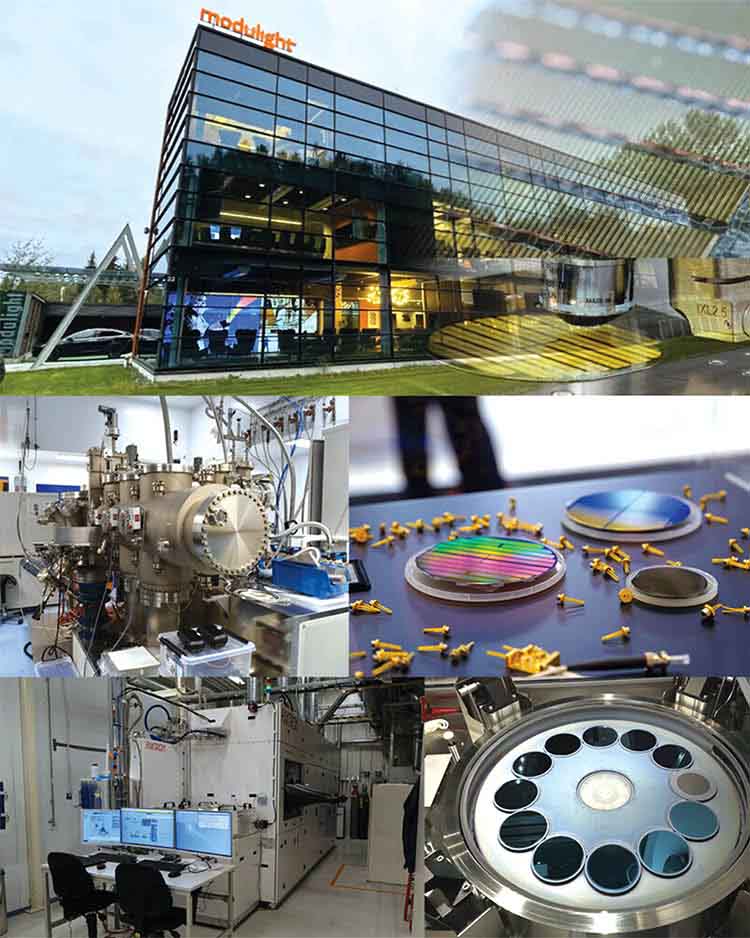
Modulight’s in-house design, epitaxial growth, and packaging capabilities support both R&D and volume production. Courtesy of Modulight.
For quantum communication and entanglement-based protocols such as quantum key distribution, it is crucial to transmit photons over long distances with minimal loss. Ultralow-loss interconnects and optical fiber technologies are indispensable to this application. Many sophisticated approaches rely on the use of highly precise strategies to maintain a strong, unobstructed signal.
Switzerland-based DIAMOND SA is one such company. It builds ultralow-loss interconnect solutions using proprietary active core alignment technology. This approach minimizes insertion loss and back reflection — two factors that critically influence quantum signal integrity. These components help to ensure that coherence is maintained during long-distance transmission, enabling the development of robust and scalable quantum communication infrastructure.
Forward outlook
Despite significant progress in the development of many photonic solutions that have become core to the ability to scale quantum technologies, several challenges endure. Quantum photonics requires extreme precision in fabrication, material purity, and alignment. For example, the integration of disparate materials — such as III-V semiconductors for lasers and silicon for passive photonics — adds complexity to manufacturing workflows.
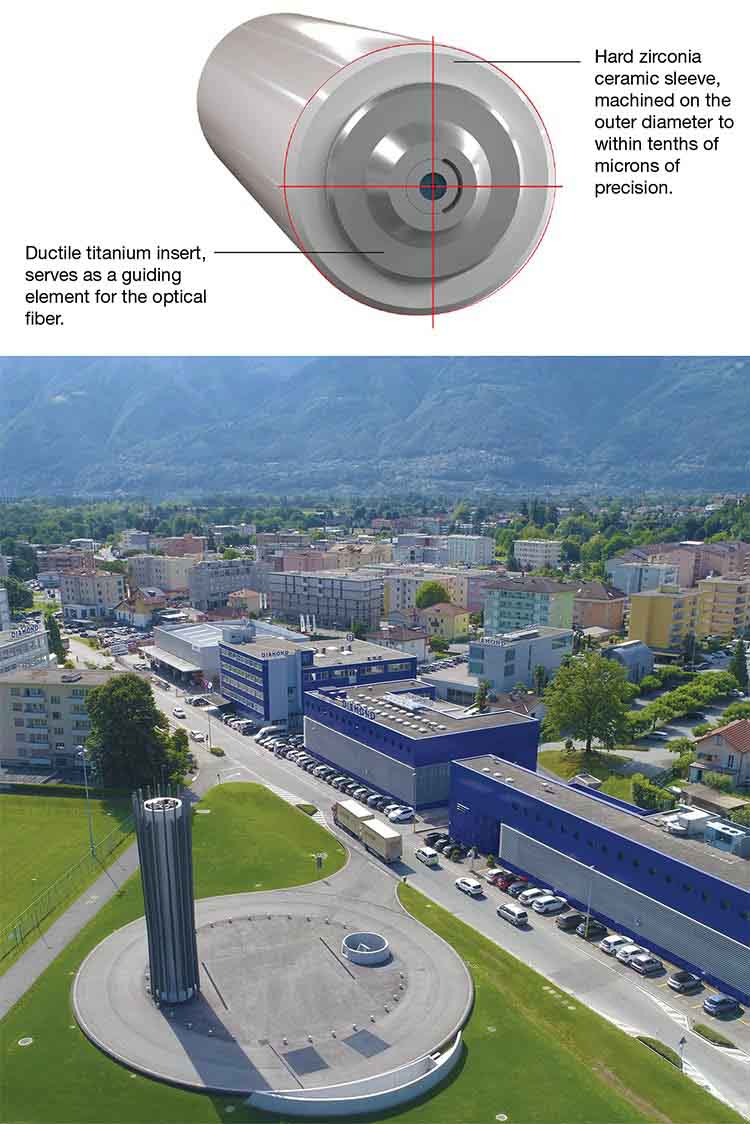
(top) Switzerland-based DIAMOND SA’s active core fiber alignment featuring a bicomponent ferrule Courtesy of DIAMOND SA. (bottom)The company’s headquarters. Courtesy of DIAMOND SA.
Fortunately, many industry- and government-led standardization efforts are now gaining momentum. In general terms, these initiatives aim to define interface specifications, design libraries, and performance benchmarks that facilitate interoperability and reduce development costs. The transition from research prototypes to commercial-grade quantum systems will accelerate as these standards reach maturity.
Standardization efforts are not the only aspects of the quantum ecosystem experiencing growth. The quantum photonics market is itself on a steep growth trajectory. According to market analyses, the global market is expected to grow from approximately $700 million in 2025 to approximately $5 billion by 2033, at a compound annual growth rate of 33%1-3. Key growth drivers include demand for secure communication technologies — especially in defense and finance — quantum sensing in medical and geophysical applications, and quantum computing in sectors such as logistics, finance, and pharmaceuticals.
The U.S. currently leads in quantum photonics. This is due to a combination of strong public and private investments, academic-industry collaborations, and government policy support. However, the Asia-Pacific region is projected to be the fastest-growing market during the next decade. Rising R&D efforts and adoption across diverse verticals are fueling this anticipated growth.
This simultaneous growth and adoption of quantum photonics is the best indicator that photonics is emerging as the foundational technology underpinning quantum systems. Innovations in distinct photonics technologies and parameters — such as laser stability, photonic integration, ultralow-loss components, and compact entangled photon sources — are already solving critical bottlenecks on the road to scalable quantum systems. Now, as fabrication technologies mature and standardization frameworks take hold, industrial players have moved to the forefront of this shift.
Through their ongoing efforts to translate laboratory research into deployable systems, companies, including those mentioned here, are at once affirming the technical feasibility and the commercial viability of quantum photonics to shape the future of information technologies.
References
1. Straits Research (2023). Quantum Photonics Market Size, Share & Forecast by 2033, www.straitsresearch.com/report/quantum-photonics-market.
2. Maximize Market Research (June 2024). Quantum Photonics Market: Global Industry Analysis and Forecast (2024-2030) by Offering, Application and Verticals, www.maximizemarketresearch.com/market-report/quantum-photonics-
market/249618.
3. Allied Market Research (August 2023). Quantum Photonics Market, www.allied marketresearch.com/quantum-photonics-market-a188326.