
Light-Powered Gears Drive Chip-Size Motors
Downsizing the gears and micromotors used in devices could help reduce their footprints. But efforts to do so have been hampered by the challenges of constructing drive trains for the gears at scales smaller than 0.1 mm.
Miniaturized gears could be used to develop mechanized tools for exploring microscopic phenomena like friction and surface interactions, and could lead to innovations in microfluidics, biomedicine, and reconfigurable optics. Gears made at μm-scale could also enhance material efficiency and reduce waste.
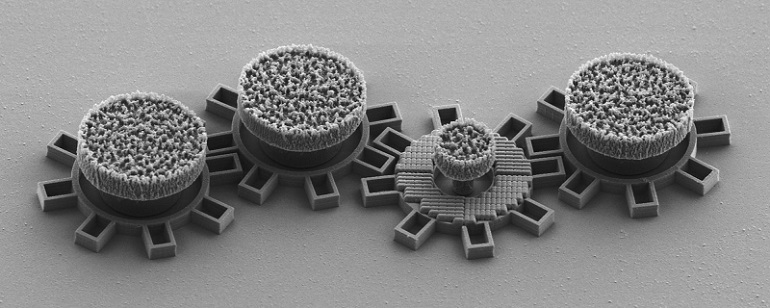
The second gear from the right has an optical metamaterial that reacts to laser light and causes the gear to move. All gears are made in silica directly on a chip. Each gear is about 0.016 millimeters (mm) in diameter. Courtesy of Gan Wang.
By using laser light instead of mechanical drives to activate gears, researchers at the University of Gothenburg miniaturized gears and motors to diameters of 10 μm and enabled precise control over individual micromotor units. Researchers from the University of Münster, Chalmers University of Technology, Uppsala University, and the University of Naples Federico II contributed to the work of the Gothenburg team.
The researchers fabricated gears with optical, silicon-based metamaterials directly on a microchip. The on-chip fabrication process, which is compatible with standard CMOS lithography, could facilitate large-scale manufacturing of the gears, and integration with other CMOS components like metalenses and plasmonic sensors.
With the gears made with optical metamaterials, the researchers developed miniaturized motors with diameters as small as 10 μm.
By shining a laser on the metamaterial, the researchers can cause the gear wheel to spin. The researchers can control the speed of the gear by regulating the intensity of the laser light, and can alter the direction of the gear wheel by changing the polarization of the light or the design of the metasurface.
The micromotors can be assembled into functional, microscopic metamachines. As a proof of principle, the researchers built microscopic gear trains, powered by a single driving gear, with a metasurface activated by a plane light wave. They also developed a pinion and rack micromachine capable of transducing rotational motion, performing periodic motion, and controlling mirrors for light deflection.
“We have built a gear train in which a light-driven gear sets the entire chain in motion,” researcher Gan Wang said. “The gears can also convert rotation into linear motion, perform periodic movements, and control microscopic mirrors to deflect light.”
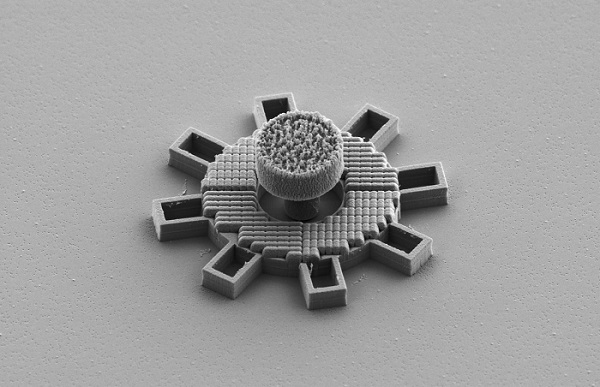
The gear has a structure that reacts to light and makes it move. Courtesy of Gan Wang.
The ability to integrate microscopically-geared metamachines onto a chip and drive them with light unlocks new possibilities for micro- and nanoscale mechanical systems. Since laser light does not require any fixed contact with the machine and is easy to control, the micromotor can be scaled to complex microsystems, and the movement of individual micromotor units can be precisely controlled.
“This is a fundamentally new way of thinking about mechanics on a microscale,” Wang said. “By replacing bulky couplings with light, we can finally overcome the size barrier.”
The researchers believe that the light-powered micro- and nanomachines could be integrated into future lab-on-a-chip systems. Light is a widely available, biocompatible energy source, making the micromotors suitable for manipulating biological matter, including bacteria and cells. A gear wheel can be as small as 16-20 μm — the same size as some human cells.
The 1064-nm laser that is used for the system minimizes damage to biological samples due to its low absorption by water and tissues. The light can be focused from a large area onto the small driving gear, and operate at a low-power requirement that is safe for biological systems. The light can be selectively directed to the driving gear, allowing it to mechanically activate passive structures without directly exposing biological samples to the light source. This non-toxic, indirect energy delivery mechanism could broaden the application of the light-driven micromotors in biomedical environments.
“We can use the new micromotors as pumps inside the human body, for example to regulate various flows,” Wang said. “I am also looking at how they function as valves that open and close.”
The research was published in Nature Communications (www.doi.org/10.1038/s41467-025-62869-6).
Published: September 2025