
Light-Based Chip Boosts AI Power Efficiency hundredfold
AI systems are increasingly central to technology, powering everything from facial recognition to language translation. But as AI models grow more complex, they consume vast amounts of electricity — posing challenges for energy efficiency and sustainability. A chip developed by researchers at the University of Florida could help address this issue by using light, rather than just electricity, to perform one of AI’s most power-hungry tasks. The chip is designed to carry out convolution operations, a core function in machine learning that enables AI systems to detect patterns in images, video, and text. These operations typically require significant computing power.
By integrating optical components directly onto a silicon chip, the researchers created a system that performs convolutions using laser light and microscopic lenses — dramatically reducing energy consumption and speeding up processing.
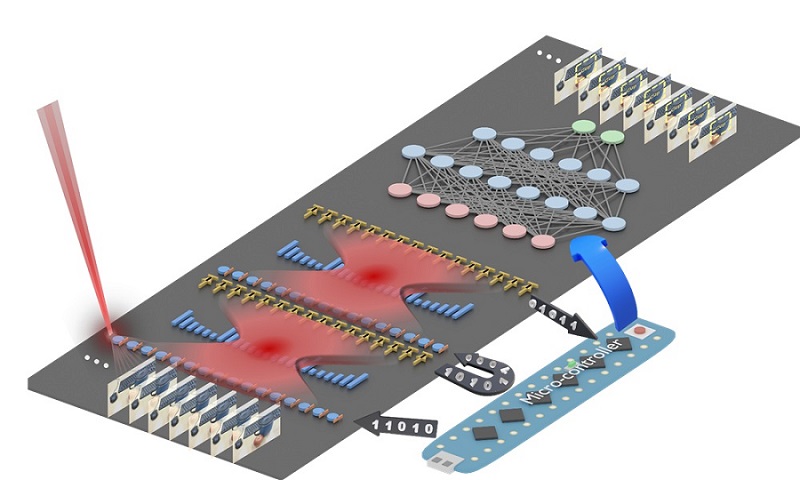
A silicon photonic chip developed by University of Florida researchers turns light-encoded data into instant convolution results. Courtesy of the University of Florida/Hangbo Yang.
“Performing a key machine learning computation at near zero energy is a leap forward for future AI systems,” said study leader Volker J. Sorger, the Rhines Endowed Professor in Semiconductor Photonics at the University of Florida. “This is critical to keep scaling up AI capabilities in years to come.”
The system uses two sets of miniature Fresnel lenses etched directly onto the chip and fabricated using standard semiconductor manufacturing techniques. To perform a convolution, machine learning data is first converted into laser light on the chip. The light passes through the Fresnel lenses, which carry out the mathematical transformation. The result is then converted back into a digital signal to complete the AI task.
“This is the first time anyone has put this type of optical computation on a chip and applied it to an AI neural network,” said Hangbo Yang, a research associate professor in Sorger’s group at UF and co-author of the study.
In tests, the prototype chip classified handwritten digits with about 98% accuracy, comparable to traditional electronic chips. The team also reported demonstrating wavelength multiplexing. And Sorger noted that chip manufacturers such as NVIDIA already use optical elements in some parts of their AI systems, which could make it easier to integrate this new technology.
The research was conducted in collaboration with the Florida Semiconductor Institute, UCLA, and George Washington University.
The research was published in Advance Photonics (www.doi.org/10.1117/1.AP.7.5.056007).
Published: September 2025