Photonics HandbookResearch & Technology
Computational Technique Harnesses the Benefits of Spectral, Photographic Insights
WEST LAFAYETTE, Ind., Sept. 19, 2025 — Using an approach that combines computer vision, color science, and optical spectroscopy, researchers at Purdue University devised an approach that enables conventional photography to be used for optical spectroscopy and hyperspectral imaging. Using the mechanism, the researchers realized spectral resolution comparable to the resolution of scientific spectrometers with photos from a smartphone camera.
A range of industries, running the gamut from agriculture, environmental monitoring, and food quality analysis, to industrial quality control, defense and security, and medical diagnostics, could benefit from the technique, according to its developers.
The researchers hypothesized that the RGB values of reference colors, as captured by a traditional camera, could be used to design a spectral color chart that could then be used to decode spectral information. The fidelity of spectral recovery would be determined mainly by the spectral incoherence among the reference colors in the chart.
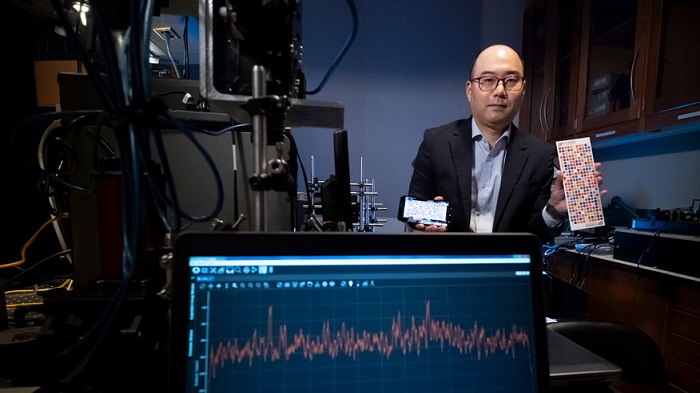
Professor Young Kim and his team have combined computer vision, color science, and optical spectroscopy to create an algorithm that recovers detailed spectral information from conventional photographs. Courtesy of Purdue University/Vincent Walter.
They developed a general computational framework, co-designed with spectrally incoherent color reference charts, to recover spectral information from a single-shot photograph. They optimized reference color selection and the computational algorithm to eliminate the need for training data or pretrained models.
The spectral color chart, together with the device-informed computation, can be used to recover spectral information from RGB values acquired using conventional cameras, such as smartphone cameras.
In transmission mode, data is acquired by photographing the spectral color chart through the sample of interest. Altered RGB values of reference colors are used to recover the spectral intensity of the sample. In reflection mode, the sample of interest is placed alongside the spectral color chart to recover the sample’s spectral hypercube without needing a hyperspectral imaging system. A spectral hypercube of the sample can be constructed from a single-shot photo, analogous to hyperspectral imaging.
The technique, which the researchers called computational photography spectrometry (CPS), has the potential to make optical spectroscopy and hyperspectral imaging accessible with off-the-shelf smartphones. Instead of limiting the user to multispectral data with only a few bands, the technique enables a high spectral resolution of 1-2 nm.
“Importantly, the spectral resolution — around 1.5 nm — is highly comparable to that of scientific spectrometers and hyperspectral imagers,” researcher Semin Kwon said. “Scientific-grade spectrometers have fine spectral resolution to distinguish narrow spectral features. This is critical in applications like biomedical optics, material analysis, and color science, where even small wavelength shifts can lead to different interpretations.”
Although methods exist to estimate and reconstruct spectral information from RGB values acquired using conventional cameras, they are limited in their ability to achieve a high degree of spectral resolution.
The researchers developed a generalizable method for extracting high-resolution spectral information from a single-shot photo of a sample without having to rely on task-specific training datasets or predetermined models. This provides an advantage over existing machine learning models for spectral reconstruction, which depend on task-specific training data or fixed models.
The generalizability of CPS, and its ability to obtain high spectral resolution, is made possible by the integration of the specially designed color chart with the inverse computation algorithms.
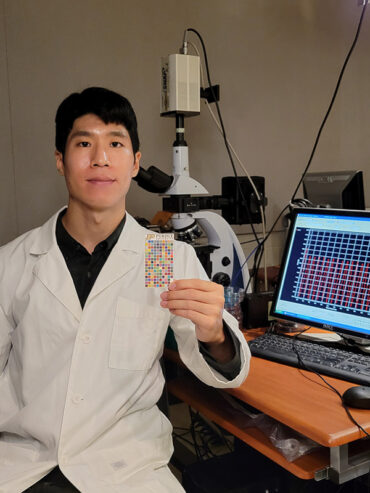
Semin Kwon is a postdoctoral research associate at Purdue University’s Weldon School of Biomedical Engineering. Courtesy of Purdue University/Semin Kwon.
“From an algorithmic standpoint, to the best of our knowledge, our paper presents the first computational spectrometry method with 1.5-nm spectral resolution using a photograph of an arbitrary sample without relying on specific training data or predetermined algorithms,” professor Young Kim said.
The spectral color chart and device-informed computation eliminate the need for complex hardware, simplifying the hardware requirements for the CPS technique. And, the CPS approach could potentially offer a simple, affordable, portable way to use smartphones for optical spectroscopy and hyperspectral imaging in day-to-day applications.
“Many mobile spectrometers require additional accessories and bulky components as mandatory attachments to smartphones,” Kwon said. “In contrast, our method leverages the built-in camera of the smartphone.”
The team is currently using the algorithm for digital and mobile health applications in both domestic and resource-limited settings.
“Photography is central to these applications, but color distortion has posed a persistent challenge, which is why we are focusing on these settings,” Kim said. “This algorithm provides a basis for quantifying and correcting colors, enhancing the reliability of medical diagnostics.”
The researchers believe that the generalized computational photography spectrometry technique could change how industry uses smartphones.
“A photograph is more than just an image. It contains abundant hyperspectral information,” Kim said. “We are one of the pioneering research groups to integrate computational spectrometry and spectroscopic analyses for biomedical and other applications.”
A patent for the algorithm is pending. Industry partners interested in developing or commercializing the algorithm should contact Patrick Finnerty, assistant director of business development and licensing-life sciences, at Purdue University.
The research was published in IEEE Transactions on Image Processing (www.doi.org/10.1109/TIP.2025.3597038).
Published: September 2025