Photonics HandbookBioScan
Caltech Research Enables Spectral Broadening On-Chip
Broadband, coherent light sources are highly valued in R&D. But until now, they have been difficult to achieve without bulky, inefficient tabletop devices.
A Caltech team led by professor Alireza Marandi developed an efficient solution to integrating a broad spectrum of frequencies on a microchip. Using an optical parametric oscillator (OPO), the team demonstrated multi-octave frequency comb generation on a nanophotonic device with a threshold of only femtojoules (fJ) of pump energy.
The nanophotonic device has the potential to provide ultrabroadband (visible to MIR), on-chip light sources for applications in areas ranging from communications and imaging to spectroscopy.
To generate a frequency comb on a chip, the researchers engineered an OPO in lithium niobate (LiNbO3) and used dispersion engineering to shape the way that different wavelengths traveled through the device. An OPO is essentially a resonator that traps incoming laser light at one input frequency and uses a nonlinear crystal to generate light at different output frequencies. Typically, OPOs serve as laser-like light sources with tunable output frequencies. But. by using dispersion engineering in the work, the researchers ensured that the wavelengths remained together instead of spreading out.
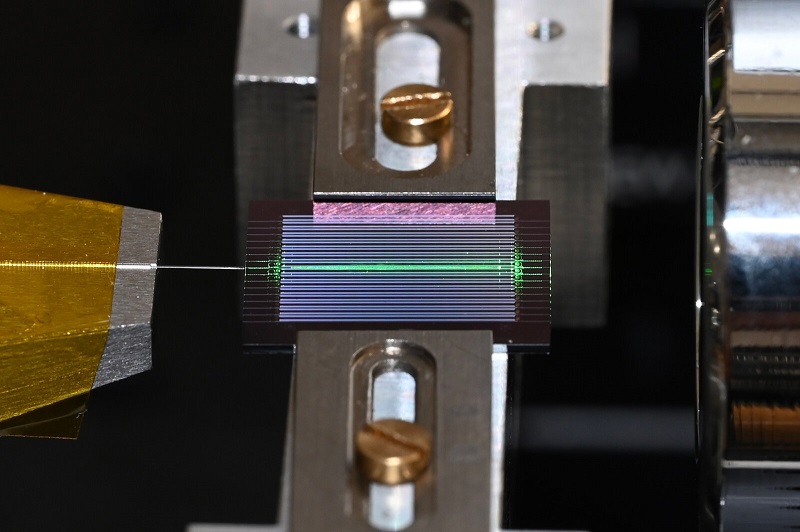
The experimental setup shown here incorporates on-chip optical parametric oscillator (OPO) technology to generate a frequency comb of laser-like light covering a wide range of frequencies with very little input energy. In this image, the chip includes about 20 OPOs, and one of them is being tested. An optical fiber is shown to the left of the chip and a free-space objective to the right. Courtesy of Caltech/Alireza Marandi.
The device demonstrated highly efficient, highly stable coherent spectral broadening with the OPO — a result that the team initially did not expect. “We turned it on and cranked up the power, and when we looked at the spectrum, we saw that it was extremely broad,” Marandi said. “We were particularly surprised that the super-broad spectrum was actually coherent. This was against the textbook descriptions of how OPOs work.”
In subsequent simulations, the researchers found that raising the incoming light energy above the threshold caused the spectrum to become incoherent — and therefore unable to generate a frequency comb. However, in the lab, the spectrum continued to remain coherent even when the device operated far above the threshold.
By leveraging an ultralow threshold and dispersion engineering, the researchers had accessed a previously unexplored OPO regime that enables coherent spectral broadening.
“It took us maybe six months to discover that there is this new regime of OPO operation in which the OPO is far above its threshold and the coherence is reestablished,” Marandi said. “Because the threshold of this OPO is orders of magnitude lower than previous OPOs, and the dispersion and the resonator are engineered unlike the previous realization of OPOs, we could observe this phenomenal spectral broadening, which is orders of magnitude more energy-efficient than other spectral broadening schemes.”
Creating a multi-octave frequency comb from an OPO could enable ultrabroadband, on-chip, nonlinear photonic capabilities for numerous applications.
One of the primary techniques used to make stable frequency combs requires significant broadening of the comb’s spectrum. The energy demands of this spectral broadening have, so far, created a bottleneck that has impeded the integration of frequency comb technologies on-chip. The team’s approach to building frequency combs could reshape how frequency comb-based technologies, currently found in table-top setups, could transition to integrated photonic devices.
Moreover, most of the advanced lasers and detectors used for measuring molecules operate in the NIR or visible range. OPOs that are launched from NIR lasers as the input frequency, and are then able to efficiently convert the light, outputting coherent light in the MIR range, could allow researchers, for example those working with spectroscopy, to access relevant information at lower frequencies.
“There have been two main challenges with frequency combs,” Marandi said. “One is that the sources are too big, and the second is that it’s challenging to make them in different desired spectral windows. Our work offers a path toward solving both of these problems.”
The research was published in Nature Photonics (www.doi.org/10.1038/s41566-025-01753-7).
Published: September 2025