Photonics Handbook
Alternative Methods to Laser Crystal Growth Aim to Curb Reliance on Rare-Earth Materials
KARLSRUHE, Germany, June 11, 2025 — Researchers at Fraunhofer Institute of Optronics, System Technologies and Image Exploitation IOSB (Fraunhofer IOSB) are researching alternatives in crystal growing and processing, as well as glass fiber development due to the scarcity of rare-earth materials that are required for producing lasers. According to a press release from the Institute, due to customs disputes, the laser industry and defense companies are struggling with a supply shortage of rare-earth elements. The elements are needed for laser crystals and active laser fibers as an amplification medium to generate laser radiation, among other applications in laser production.
Laser crystals are integral to every laser, amplifying light by storing optical energy at higher energy levels. Additionally, depending on their doping with certain rare-earth elements, these crystals release this energy —as laser radiation — at defined wavelengths. If there are no laser crystals available for certain wavelengths, a conversion using nonlinear optical materials is possible. These materials can convert the wavelengths of a laser beam, halving, tripling, or mixing several wavelengths. Applications involving laser radiation that can damage the eyes, such as distance measurements, can be shifted to harmless wavelength ranges using these optical materials. These sources enable new applications in medical technology, environmental analysis, and defense.
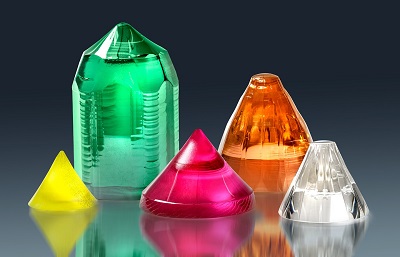
Various oxide laser crystals with different active dopants. Courtesy of Fraunhofer.
For both laser and nonlinear optical crystals, the quality of the available crystals has historically been a limiting factor. “In addition to the doping, the optical quality and absorption as well as the thermal conductivity and polarization properties of the crystals play a decisive role in their performance,” said Marc Eichhorn, director of Fraunhofer IOSB. This can result in temperature differences within the crystal at higher performance levels, which negatively affects efficiency and beam quality.
Additionally, said head of the Fraunhofer IOSB laser technology department, Christelle Kieleck, “Raw crystals have to be cut, ground, polished, coated, or micro-structured. This particular processing method is crucial in ensuring efficiency and resilience.”
The researchers first simulated the composition of the crystals by gradually varying the degree of doping and the growing conditions to improve their properties. They then grew the crystals in scientific furnaces and examined them using X-ray diffraction. High pressures and safety requirements pose a challenge to the production process. In the laboratory, the optical components were then sawed out of the crystals, processed, and then polished. The researchers set up a test stand that uses measurement technology to determine optical damage thresholds. Finally, the sources were tested in laser systems, which in turn were optimized according to crystal quality and geometry.
Eichorn said, “Guaranteeing the availability of adequate laser crystals and fibers and having control over their processing is vital not only for the competitiveness and independence of the German and European economies but also for our security.”
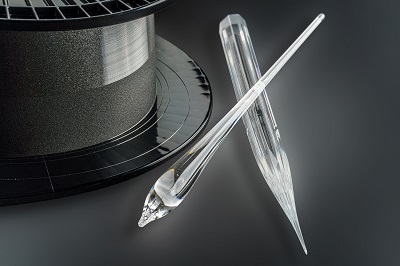
Octagonal fiber preform, glass gobs from the beginning of the fiber drawing process and active laser fiber on carrier roller. Courtesy of Fraunhofer.
In addition to crystals and nonlinear optical materials, the researchers are also developing active laser fibers and new fiber components for specific applications, from material processing to laser surgery. The research focuses on the short-wave and mid-infrared spectrum. To generate laser radiation in fiber lasers, the researchers are focused on rare-earth-doped quartz glass fibers and fluoride laser fibers.
/Buyers-Guide/Fraunhofer-Institute-for-Material-and-Beam/c30990